Charlotte Deane, Professor of Structural Bioinformatics, University of Oxford
Women in AI at Oxford · Profile Series

Charlotte Deane

Using AI to make drug discovery faster, cheaper and more open.

Read

Most drugs are expensive because they are hard to make. The ones that get made are the ones that will sell. For Professor Charlotte Deane, that is the problem AI needs to fix.

Because I could set fire to things

Charlotte Deane grew up between South London, Jordan, and Hong Kong. She announced early that she wanted to be a scientist, initially because she could set fire to things.

She describes her work simply: ‘I do AI for drug discovery.’ More precisely, she uses computational methods to understand protein structure, protein function, and how small molecules bind to targets in the human body, making drug design faster, cheaper, and better informed.

AI entered her field gradually. Having always worked on computational, statistical, and mathematical methods, she watched machine learning tools shift from secondary tools to centre stage, a natural progression rather than a sudden career pivot. She is careful to temper the current hype: while there has been a massive jump in capabilities, at some point that jump will finish and the field will return to a more standard, ‘bumbling along’ phase of incremental progress.

Watch: Charlotte Deane in conversation

Charlotte Deane in conversation, filmed at the Department of Statistics, University of Oxford · Watch on YouTube ↗

The economics of health

The traditional drug development pipeline takes ten to fourteen years and commonly costs around two billion dollars to bring a single drug to market. Nine out of ten candidates fail somewhere along the line, after years of development, testing, and clinical trials.

The ones that do survive are not necessarily working on the diseases that most need them. Finance often dictates which treatments get prioritised because commercial pharmaceutical companies must act in the financial interests of their shareholders. She’s direct about the reality this creates: ‘A large pharmaceutical company won’t work on most of the diseases that are hurting most of the people on the planet, because they cannot recoup the cost.’

Outside of pandemic vaccines, the highest-revenue drugs of recent times have included Pfizer’s Viagra and the GLP-1 weight-loss family, driven by wealthier markets that can pay. Diseases affecting large populations in lower-income countries often remain largely untouched – not for a lack of science, but for lack of a market that can return the investment.

If computational tools can accurately predict which molecules will work before they ever hit a lab, the traditional timeline shrinks. Even a ’modest‘ shift, bringing the failure rate down from nine out of ten to seven out of ten, alters the economics considerably. It cuts years of development, saves millions of dollars in failed trials, and lowers the financial barrier to targeting diseases that disproportionately affect the world’s poorer communities.

“There’s no other way to do it. You have to make it cheaper and you have to make it faster.”

10–14
Years it typically takes to bring a single drug from discovery to market
~$2bn
Estimated average cost of bringing a drug to market, including the cost of failures
9 in 10
Drug candidates that fail before reaching patients, despite years of prior work

Mind the gap

It was during the peak of this hype cycle that she and a student were looking through a newly published set of results from AI models designed to predict how small molecules bind to protein targets. On paper, the statistics were extraordinary. Unprecedented, even. But looking closely, they realised the models had no grasp of basic physics: atoms overlapping impossibly, molecules drifting unnaturally inside proteins as though matter didn’t apply.

They were the first to publish on it. ‘The minute you see it, it’s obvious.’ Then a stranger feeling – a millisecond of wondering whether surely everyone else must already know this. ‘At that point in time, the only two people in the world who knew that were us. We tried to tell the rest of the world quite fast.’

Her current work on OpenBind is focused on generating vastly better raw training data for large-scale prediction models to train on. Without a substantive body of varied training data, AI models have a tendency to ‘overfit’. The model memorises the data it was trained on rather than understanding the data and the grounding conditions.

‘Large language models write English well because they’ve absorbed the whole internet; they’re lousy at Welsh simply because there isn’t enough of it,’ she explains.

Deane compares it to teaching an AI language model using only a handful of authors. Start with Dan Brown and the model learns one narrow style. But add Iris Murdoch, James Joyce, Ernest Hemingway and Dr Seuss, and its understanding becomes richer and more representative.

OpenBind is attempting something similar for drug discovery. The project maps how small molecules bind to protein targets, the interaction that determines whether a medicine will actually work in the human body. By collecting ten times the volume of data currently available in the public domain on protein-molecule interactions, the project will provide the next generation of models with a much broader dataset to learn from.

“We’re generating the data itself and putting it out in the public domain so that everyone can use it.”

You’re allowed to say this isn’t right

Charlotte’s account of being a woman in science is direct. More than once early in her career, she arrived at an academic meeting only to be asked by someone to pour the coffee. It would sometimes take a few minutes for her to register the underlying assumption: that they thought she was an administrator.

But she also notices the changes. It used to be the case, she says, that every room she walked into she would probably be the only woman there. That is not so true anymore.

What she thinks has mattered most is not the numbers, but the permission to name the problem. ‘You’re allowed to say out loud that this isn’t quite right. That’s the biggest difference.‘

Support often arrived through small gestures. She remembers presenting a poster as a PhD student when Professor Dame Janet Thornton, a senior scientist who later ran the European Bioinformatics Institute, stopped to discuss her work.

A year later, at a different conference, Thornton stopped her in a corridor just to ask how her research was progressing. ‘She probably doesn’t remember doing it,’ Deane says. ‘But I do.’

Also watch Charlotte Deane: AI, Drug Discovery, and the UK Advantage
Charlotte Deane: AI, Drug Discovery, and the UK Advantage
YouTube · Agents of Tech

Adaptability over rigid structures

For those considering a career in AI, her advice is to focus on adaptability over rigid subject choices. Quantitative foundations (maths, physics, chemistry) matter, but the willingness to pivot matters more.

“If you want to work in a field that’s moving this fast, the thing you really need to be able to do is constantly learn. Pick it up, be interested in it, and run forwards with the things that you’re excited about.”

Ultimately, pushing frontiers requires a massive tolerance for things going wrong. ‘Research is a career where most of what you do does not work,’ she notes. ‘But every so often there are moments – a problem solved, a result that makes sudden sense – that make all the brick walls worth running at again.’

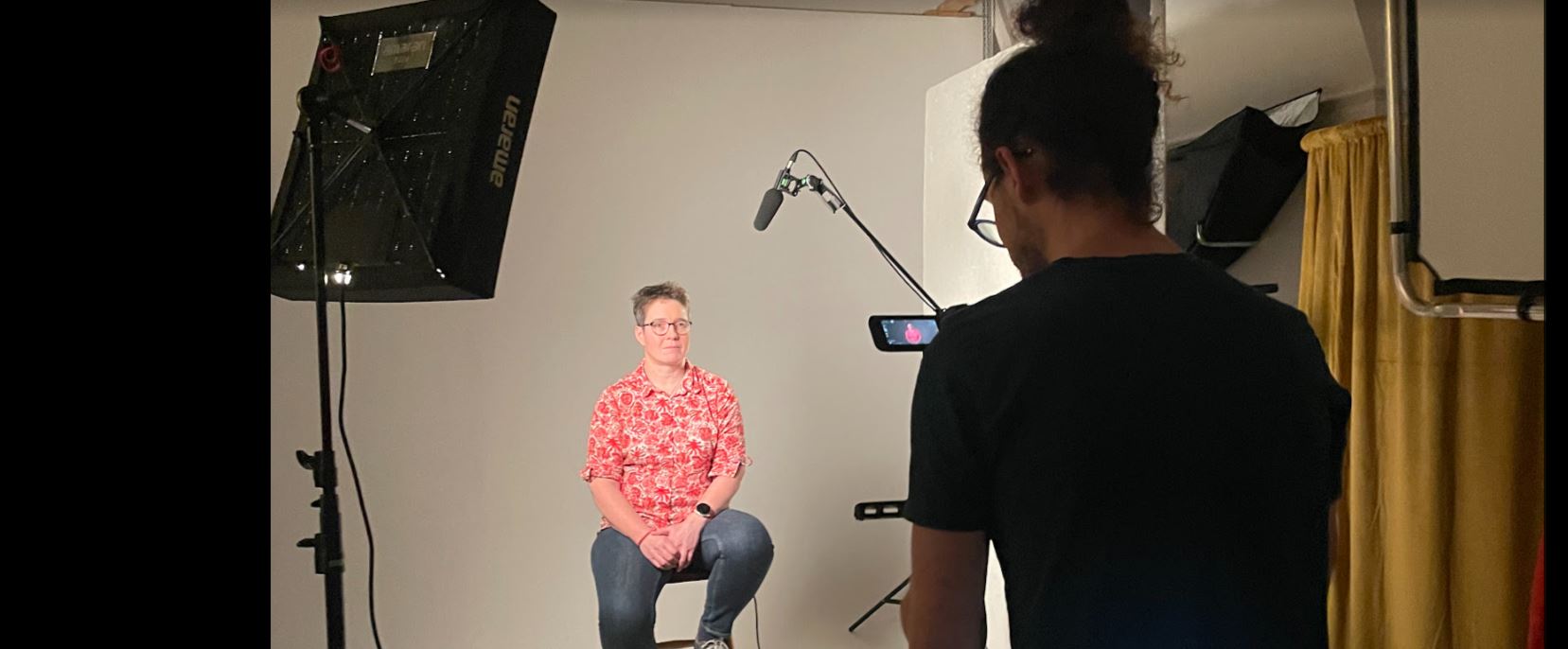
Behind the scenes of filming the Women in AI at Oxford profile series

Behind the camera: filming the Women in AI at Oxford profile series

“If we can make drug discovery a cheaper process and a faster process, we can actually work on the diseases that are hurting people all over the planet in large numbers.” – Professor Charlotte Deane MBE, Professor of Structural Bioinformatics, Department of Statistics and Executive Chair, Engineering and Physical Sciences Research Council