Natalia Ares, Associate Professor of Engineering Science, University of Oxford
Women in AI at Oxford · Profile Series

Natalia Ares

Using artificial intelligence to explore the limits of quantum technologies.

Read

For Professor Natalia Ares, the aim is not simply to build a faster computer. It is to build one that can do things no computer has ever done, and she is working on the hardware that could make that possible.

Maths, experiments, and the laws of physics

Ares grew up in Argentina, where mathematics was an early interest. ‘I found mathematics quite natural to me,’ she says. At first, however, she was unsure how that interest might translate into a career. ‘What I didn’t know was how I could use that: what type of careers I could study to do maths.’

The answer began to emerge when she took part in a science course aimed at high-school students interested in research. The programme was organised by early-career academics and introduced students to a range of scientific disciplines. ‘There I met mathematicians, physicists and chemists,’ she recalls.

Through that experience she realised that while mathematics appealed to her, she was equally drawn to experiments: designing ways to test ideas and observe how nature behaves. ‘I realised that the best combination of maths and experiments was physics.’

“I realised that the best combination of maths and experiments was physics.”

She went on to study physics at the University of Buenos Aires, completing her undergraduate degree and a master’s specialising in quantum chaos, before moving to Grenoble for a PhD and then to the United Kingdom as a postdoctoral researcher.

Looking back, she sees this international mobility as a natural part of scientific life. ‘One of the fantastic things about science is that it’s always quite international,’ she says. ‘In all the labs that I worked in there were people coming from different parts of the world. It’s quite nice to see how we all get together with the sole interest of making research progress.’

Watch: Natalia Ares in conversation

Natalia Ares in conversation, filmed at the Department of Engineering Science, University of Oxford. Watch on YouTube ↗

“What motivates our work is the desire to break the limitations of computation.” – Natalia Ares, Associate Professor of Engineering Science, University of Oxford

Deploying machine learning on quantum hardware

For much of her early career, Ares’s work focused on quantum hardware: the physical systems that could form the basis of future quantum computers. Her first real engagement with AI came through a collaboration with Professor Maike Osborne, a colleague in engineering science who works on machine learning.

‘When he was describing the kind of things that AI is capable of,’ she says, ‘I was like: we need that. We need to deploy these methods on our hardware.’

The collaboration began around 2018, initially as an experiment. ‘We started this with a graduate student, Dominic Lennon,’ she recalls. ‘Well, let’s see what we can do.’

What followed changed the way the group approached their research. Quantum devices are extremely complex systems that can operate under many different conditions, depending on how parameters such as voltages or fields are configured. Traditionally, researchers explore those conditions manually, a slow and expensive process that means experiments often focus on only a small part of the possible parameter space.

‘We were working with quantum hardware, but we were exploring them only partially,’ Ares explains. AI offered a way to automate that exploration.

“If you automate this, you can explore the whole capability space of quantum hardware.”

From scratch to a working device, automatically

Machine learning systems can systematically test configurations and identify useful behaviours much more efficiently than researchers working manually. ‘We have found regimes that we wouldn’t have found if doing this manually,’ Ares notes.

In recent work published in Nature Electronics, Ares and her collaborators showed that AI can take a device from an unconfigured state to a fully functioning quantum system automatically. ‘You can go from scratch to a working quantum device entirely automatically,’ she says.

These insights become increasingly important as devices grow in scale. ‘As you grow the number of devices, they start interacting with each other and the problem becomes unmanageable,’ she says. The ability to automate that process is therefore crucial for scaling up quantum technologies.

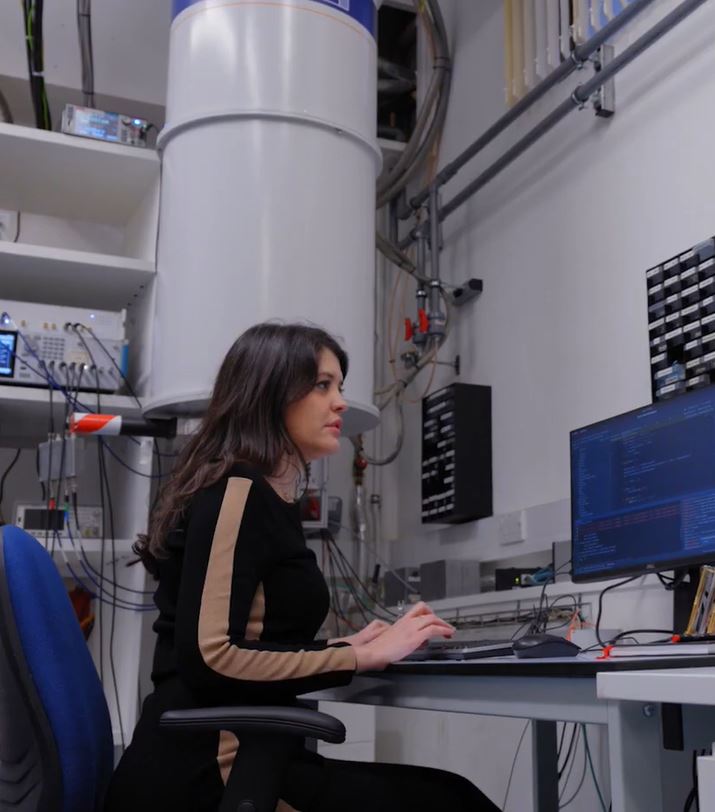
Natalia Ares in the quantum hardware laboratory, Department of Engineering Science, University of Oxford

Natalia Ares in the lab

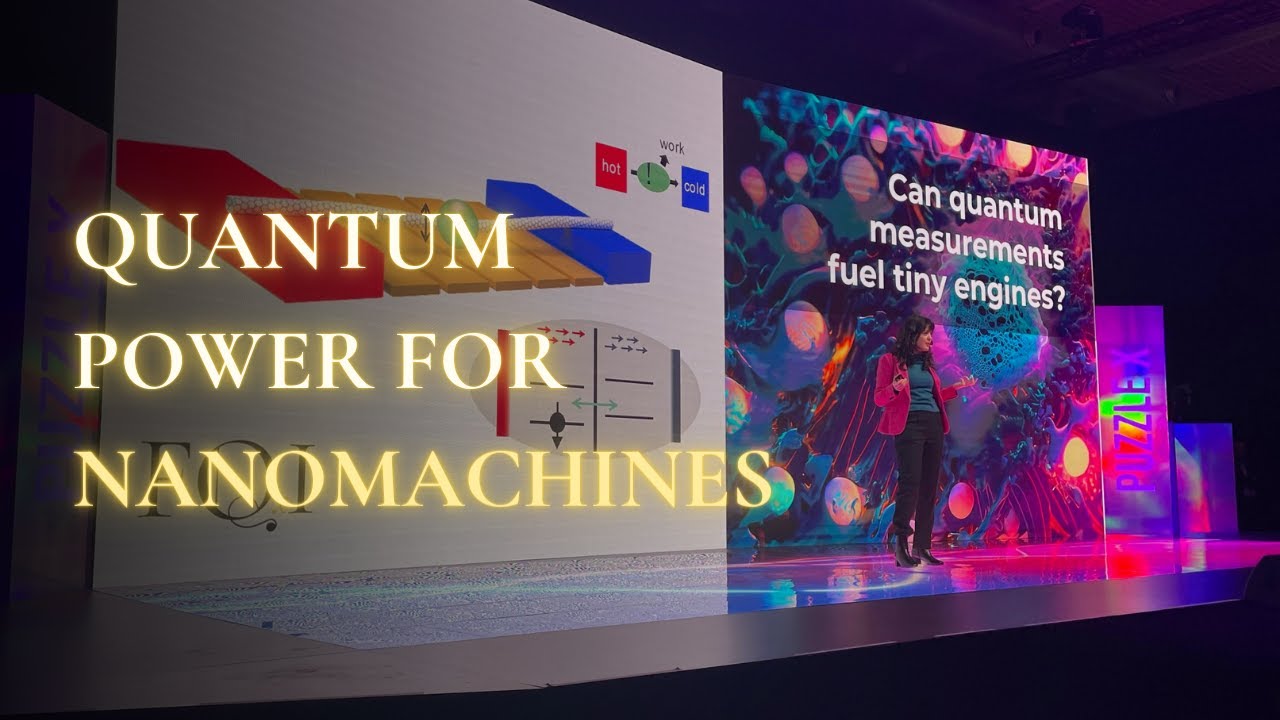
Also watch Natalia Ares speaking at a research conference
Natalia Ares speaking at a research conference
YouTube
~1 nanosecond
Quantum devices can switch state in as little as 1–10 nanoseconds – billionths of a second.
~0.02K
Operating temperature of quantum devices in Ares’ lab
10⁻⁷ metres
A semiconductor channel can be as small as 10 nanometres – 1,000× thinner than a human hair
Behind the scenes of filming the Women in AI at Oxford profile series

Behind the camera: filming the Women in AI at Oxford profile series

An entire set of new possibilities

Today’s computers rely on bits: binary digits that can take the value zero or one. Quantum systems operate according to different principles. Instead of two states, they can exist in combinations of many states simultaneously, processing a vast number of possibilities at once rather than working through them one by one.

‘We have an entire set of possibilities to compute on,’ Ares says. That could eventually enable calculations far beyond the reach of classical computers: simulating new materials, modelling drug interactions, solving problems in climate and energy that currently take years or can’t be tackled at all.

Her group’s work sits at the heart of making that practical: building and tuning the hardware that quantum computing actually needs.

For Ares, that practical challenge is inseparable from the thrill of not yet knowing what you’ll find.

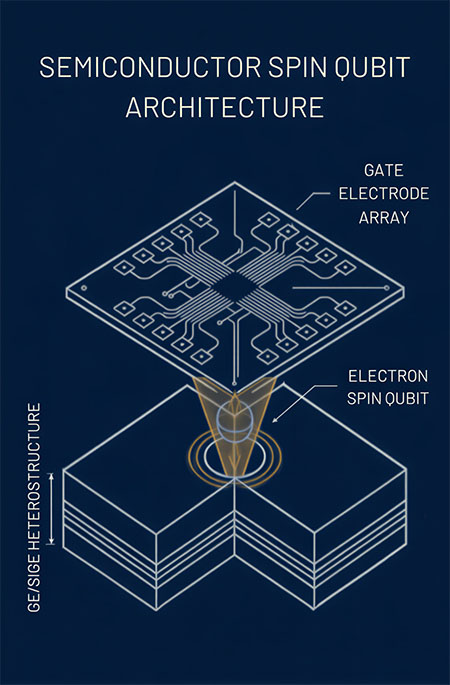
Schematic representation of a gate-defined spin qubit in a Ge/SiGe heterostructure

Schematic representation of a gate-defined spin qubit in a Ge/SiGe heterostructure

“What is really exciting is to be at the frontiers of knowledge: when you realise that you’re uncovering something that is new and that you don’t understand, and you have to find out what’s going on.”

Pushing the limits of knowledge

Like many researchers working on emerging technologies, Ares is aware that rapid innovation also brings risks. ‘Technology moves very fast,’ she says. ‘We think about the ethical implications sometimes not as fast as technologies develop. We have to be thinking about these issues while we are developing these technologies.’

Throughout her studies and early career, Ares was often one of relatively few women in her field. ‘When I started working in the field, I was always a minority in my courses.’ At the time, she didn’t let it stop her. ‘I didn’t think much about it; it was like, okay, this is what it is.’ Over time, however, she became more aware of the challenges women face in science, and notes that support from networks was essential. ‘I don’t think I could have made it if not for the help of some extraordinary women.’ One of those figures was Professor Sonia Contera.

Her advice to early-career researchers is direct: ‘Build a network. Ask for help. Skills can be acquired. You need curiosity and a passion for pushing the limits of knowledge.’

Over the next decade, Ares hopes to apply these tools to increasingly complex systems. At the same time, she is interested in exploring the reverse relationship: whether quantum devices might eventually improve machine learning itself. ‘What are the limits of learning for machines?’ she asks.

“The people who develop technologies shape the technologies.” – Natalia Ares, Associate Professor of Engineering Science, University of Oxford