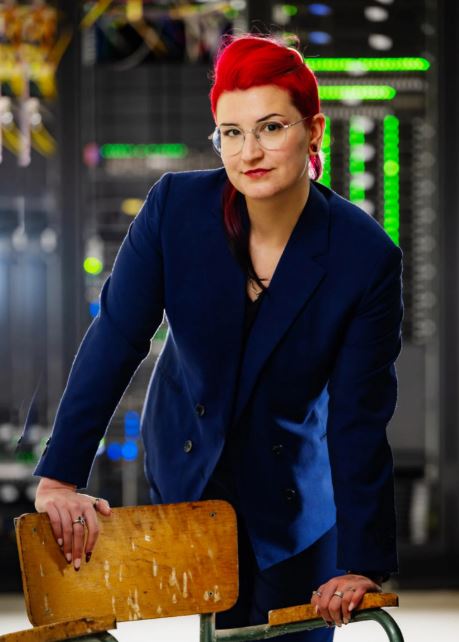
Héloïse Stevance, Schmidt AI in Science Postdoctoral Fellow, Department of Physics, University of Oxford
Women in AI at Oxford · Profile Series

Héloïse Stevance

Building virtual research assistants to help astronomers find exploding stars.

Read

Every night, our telescopes generate millions of new signals. The question is not just how to find the real ones, but what we risk losing when we let a machine decide what is boring. Dr Héloïse Stevance is working on both.

Don’t say no to yourself. Just try it.

Born and raised in France, Stevance moved to the UK to study Physics and Astrophysics at the University of Sheffield, where an exceptional group of astronomers taught her things she still uses today. In her fourth year she was sent to La Palma in the Canary Islands to spend a year as a support astronomer at the Isaac Newton Telescope, learning how telescopes work, and when they don’t.

She nearly didn’t choose astronomy at all. “I didn’t think I was good enough at physics.” An older friend offered simple advice: ‘Don’t say no to yourself. Just try it.’

‘And I’m still here.’

Her PhD at Sheffield focused on the three-dimensional shape of supernovae using a technique called spectropolarimetry. She then moved to New Zealand for three years to study the genealogy of exploding stars at the University of Auckland, before coming to Oxford in 2023 on the Schmidt AI in Science Postdoctoral Fellowship to build the virtual research assistants she had long envisioned.
“Looking at supernovae dying in distant galaxies is like looking back on our own history.”

Spot the difference with the universe

Stevance works with international sky surveys that play spot the difference with the universe. Her focus is exploding stars (supernovae) in distant galaxies: light from events that happened millions of years ago, only now reaching us.

The reason those explosions matter goes deeper than curiosity. Most of the elements we are made of were forged in these stellar deaths. Every time she sees one, she says, ‘you feel like a child at Christmas.’

Watch: Héloïse Stevance in conversation

Héloïse Stevance in conversation, filmed at the Department of Physics, University of Oxford · Watch on YouTube ↗

Delegating scientific judgment

When a sky survey compares images taken nights apart, it generates millions of differences. Most are artefacts. Finding the genuine events is a task that would take a human analyst a year to complete manually. And the data arrives every single night.

Around seven million sources change in some way every night in the Rubin data alone.

But delegating to a machine carries a risk that goes beyond efficiency. ‘When we tell a computer to decide, we aren’t just delegating a task, like doing a hard sum. We are delegating scientific judgment. And if the computer is wrong, we don’t just lose time – we lose the science.’

Stevance builds what she calls virtual research assistants: algorithms trained to follow the same logic astronomers use to separate the real from the false, the interesting from the routine. ‘Instead of looking at millions of differences, we can look at a few dozen and decide what science we want to do that day.’

“If you have 10 million alerts a night, and you spend just one second looking at each one, it would take you 115 days to get through a single night’s data.”

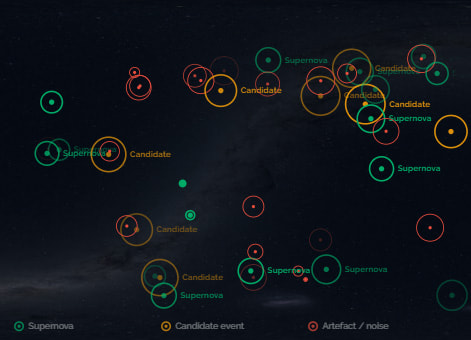
Every night, millions of sources change across the sky. A virtual research assistant filters the stream, surfacing the handful of events worth a human astronomer’s attention.

An animation showing millions of astronomical alerts streaming in nightly from sky surveys. A virtual research assistant filters the stream, distinguishing genuine supernovae candidates from noise and artefacts, and surfaces a handful of events worth a human astronomer’s attention each night.

A star map showing supernovae, candidate events, and artefacts/noise flagged across the night sky by the virtual research assistant

Artist’s impression using An Elsewhere Starfield from NASA’s Scientific Visualization Studio

Filtering out the noise

The Vera C. Rubin Observatory is a new wide-field survey telescope in Chile that had first light in June 2025. It points at a patch of sky, takes a picture and repeats, returning to the same patch every two to five days for the next ten years. In its first year alone it will deliver more data than every other sky survey humanity has ever done combined.

In the UK, Lasair (a system built by a team from Queen’s University Belfast, the University of Edinburgh and the University of Oxford) distributes Rubin’s alerts directly to astronomers across the country. Stevance built the automated filter within it that identifies extragalactic explosions from the stream of incoming data. When the system went live and began processing real alerts for the first time, the moment mattered.

‘Anyone who works with computers expects their code to break when it meets the real world, but it worked on day one.’

What she hopes to find in the Rubin data is something extraordinarily difficult to observe until now: precursor activity in stars just before they go supernova. Computational models of this period tend to fail. ‘Our models tend to crash just before that point.’ The only way to study it is to observe it directly. Vera Rubin will allow her to detect those precursor events out to three hundred million light years from Earth.

Dr Héloïse Stevance

Credit: William Beaucardet

Dr Héloïse Stevance

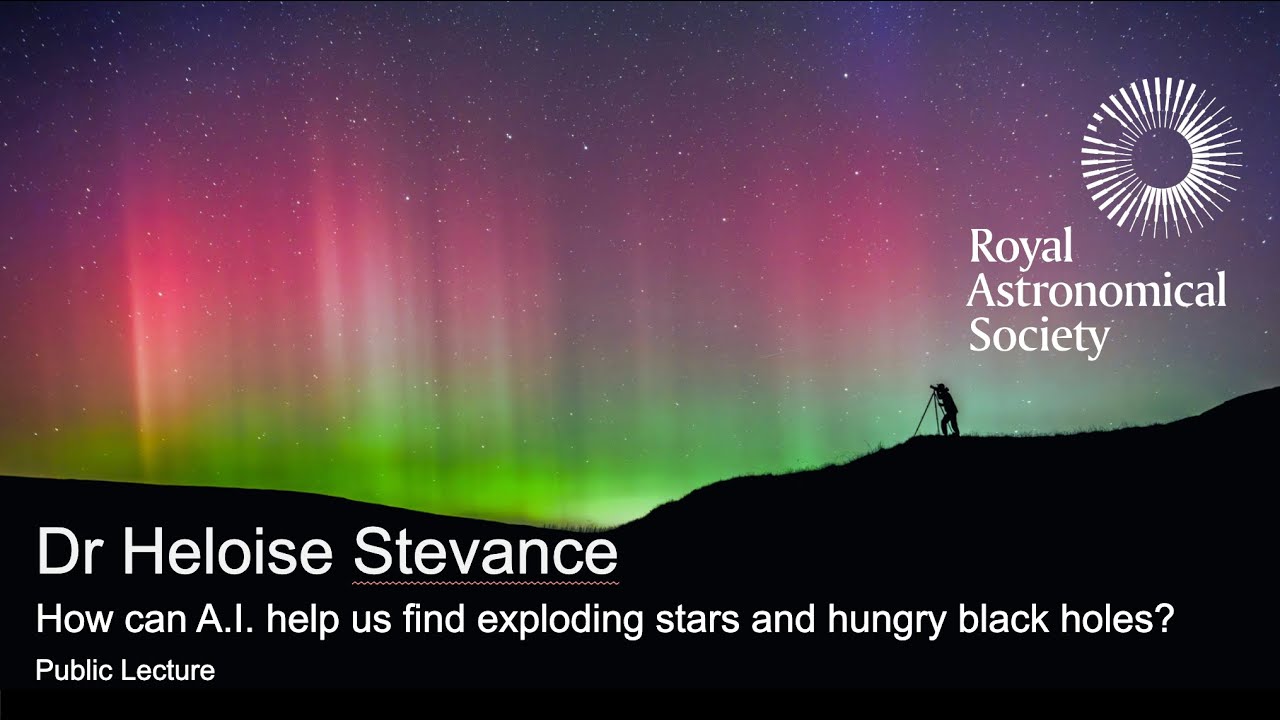
Also watch Royal Astronomical Society public lecture: How can AI help us find exploding stars and hungry black holes?
Héloïse Stevance – Royal Astronomical Society public lecture
YouTube · Royal Astronomical Society
100M
Light years from Earth that Vera Rubin can detect precursor supernova events
~7M
Sources that change in some way every single night in Vera Rubin’s images
85%
Of ATLAS alerts now handled by the Virtual Research Assistant – with Rubin data to follow

We can delegate the labour. We must never delegate the responsibility.

01

Open data, not open-washing

There is a trend Stevance calls open-washing: releasing code publicly while keeping the training data private. ‘If I don’t give you the training set, my code is useless to you. You can’t verify it. You can’t see the biases I might have accidentally baked into it.’ Software, she argues, is only open if the data is open.

02

Data legacy

The filters written into AI systems today will define what future generations believe to be true. ‘What is noise today might be a Nobel Prize discovery tomorrow.’ Scientists have a responsibility to document not just what they found, but what they chose to ignore. Otherwise they are not doing science, but generating a biased sample of reality that no one can ever correct.

03

Division of labour

The virtual research assistant handles the volume, not the judgment. It surfaces the candidates and clears the noise – the rest is science. ‘We use the machine’s speed to handle the millions of alerts, but we use the human’s intuition and physical understanding to make the final call.’

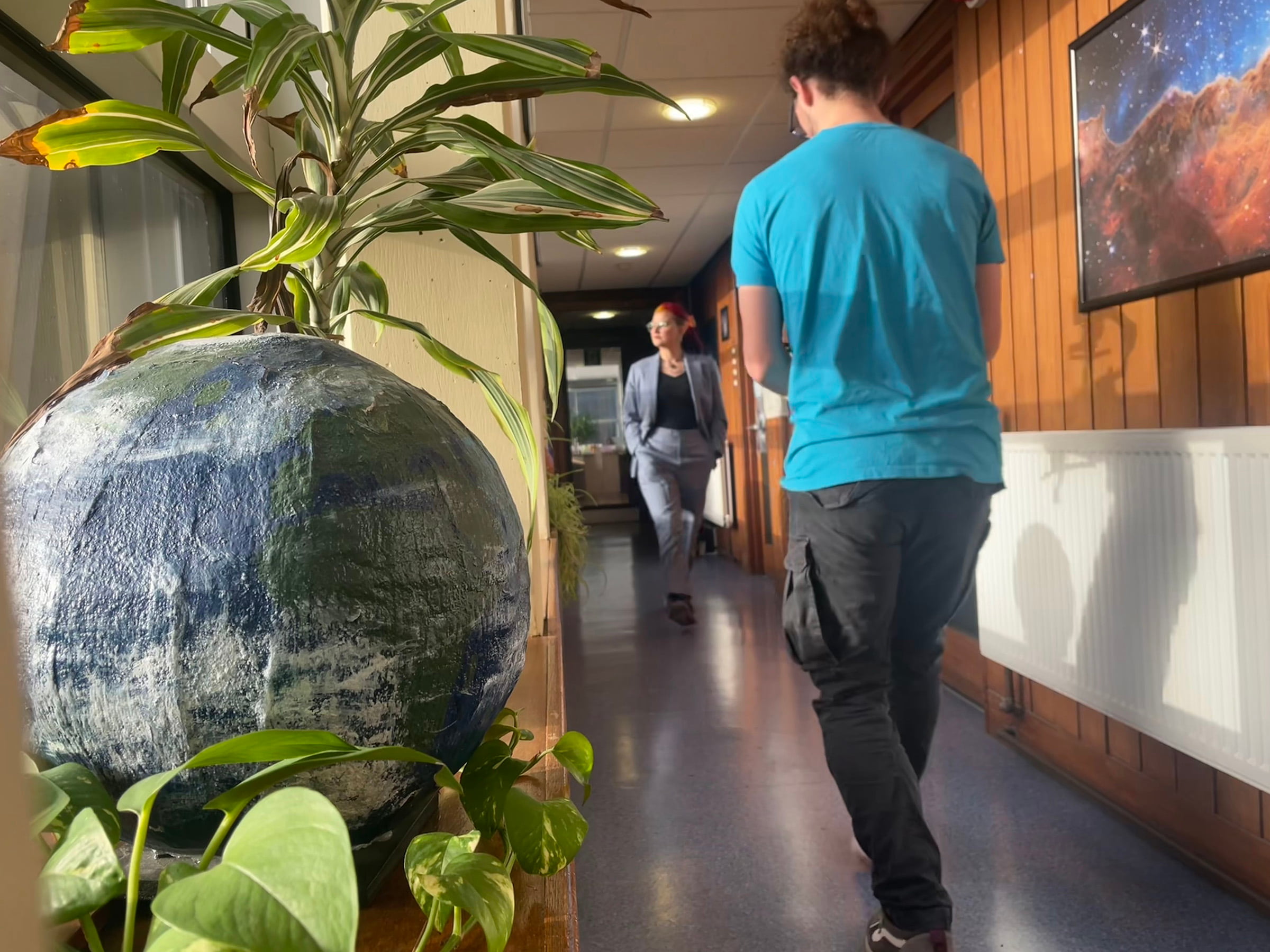
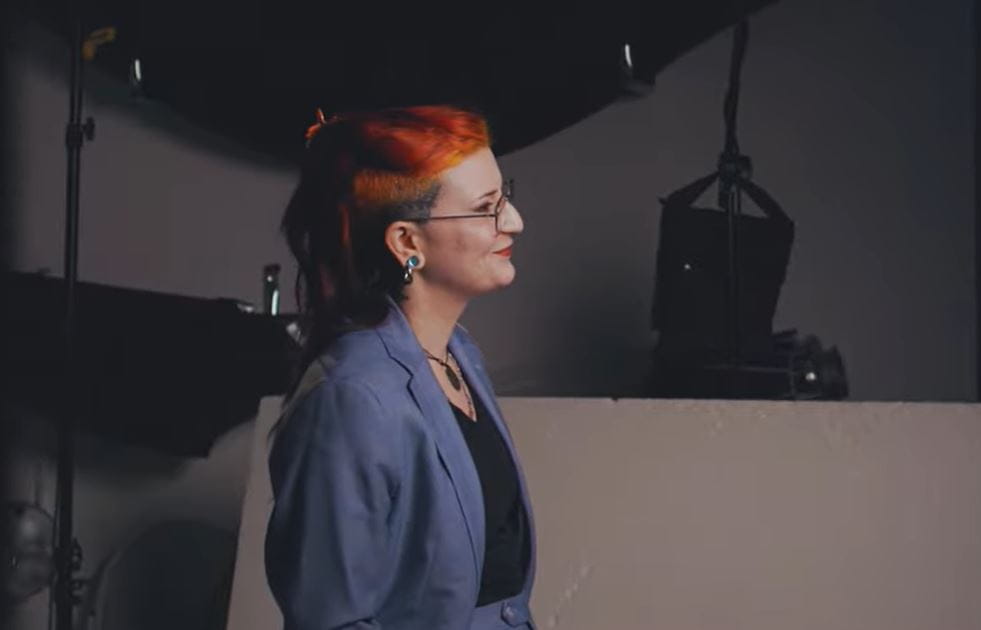
Behind the scenes of filming the Women in AI at Oxford profile series

Behind the camera: filming the Women in AI at Oxford profile series

You don’t choose institutions. You choose people.

Stevance is direct about what AI can and cannot do. Large language models, she says, are not especially useful in her day-to-day scientific work. ‘These systems don’t understand what they’re saying, and if they don’t understand, they aren’t trustworthy. Science has to be reproducible.’

She is sceptical of how the field talks about itself. Flattening intelligence into a single scale, she says, where one model is supposedly smarter than another, is something everyone should be cautious about. ‘Whenever you hear claims that one AI system is smarter than another, ask yourself: in what context? Who benefits from you believing this?’

On who should be in the room: ‘If we’re training machines to do human tasks, then we need the broadest possible range of human experiences involved. Otherwise, the systems we build will have tunnel vision.’ Culture, she adds, always trumps policy.

Her advice to her younger self inverts a famous NASA phrase. ‘There’s a famous NASA phrase: “Failure is not an option.” I would say failure is not optional. If you’re doing real science, you’re trying to solve new problems. You’re not going to get everything right first time.’

‘You never really know where you’re going to end up. You follow your curiosity and hopefully you end up somewhere you’re having a great time. And you don’t choose institutions – you choose people.’

“The sky is too vast for us to work alone: discovery in modern astronomy will have to come from a partnership between human experts and smart algorithms.” — Héloïse Stevance, Schmidt AI in Science Postdoctoral Fellow, Department of Physics, University of Oxford